

Ribbon cutting and a show off day slated for Oct. 25
By Stefan Yablonski
The renovations of Hewitt Hall brought to life the values of SUNY Oswego’s School of Communication, Media and the Arts: innovation, inspiration and interdisciplinary collaboration.
The project converted the former student union into a state-of-the-art media and visual arts center, creating an “arts corridor” between Tyler and Hewitt halls.
 For some of us — it brought back a flood of memories.
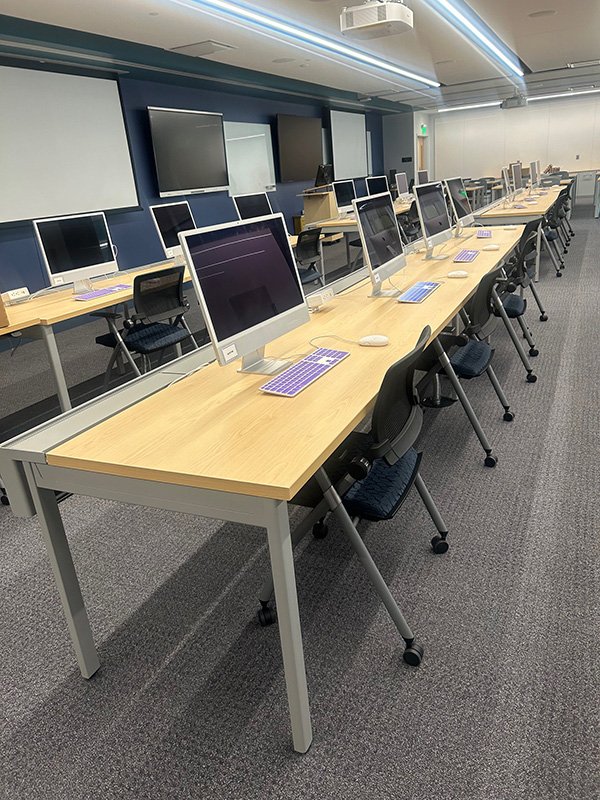
Hewitt Hall will provide 132,285 square feet of innovative teaching spaces, studios and laboratories for programs within the College of Communication, Media and the Arts.
I recently toured the building with Jennifer Knapp, dean of the College of Communication, Media and the Arts at SUNY Oswego.
The re-opening marks the completion of more than $126 million in renovations for the School of Communication, Media and the Arts.
The exterior and grounds have been modernized and updated, including an outdoor extension of the ballroom on the south side opening into a courtyard and outdoor seating around much of the building.
“It is beautiful and it is inspiring and we are all very excited,” Knapp said. “We’ll have three days of celebration Oct. 23-25. We will have our 21st annual media summit hopefully in this building — in the ballroom. If not, we will keep it in Waterman.
“We will have a ribbon cutting and a show off day Oct. 25, an open house for this building as well as Tyler; welcome in the community and alumni to have them see everything and have students demonstrate everything.”
Podcast studio, newsroom, a ballroom and much more
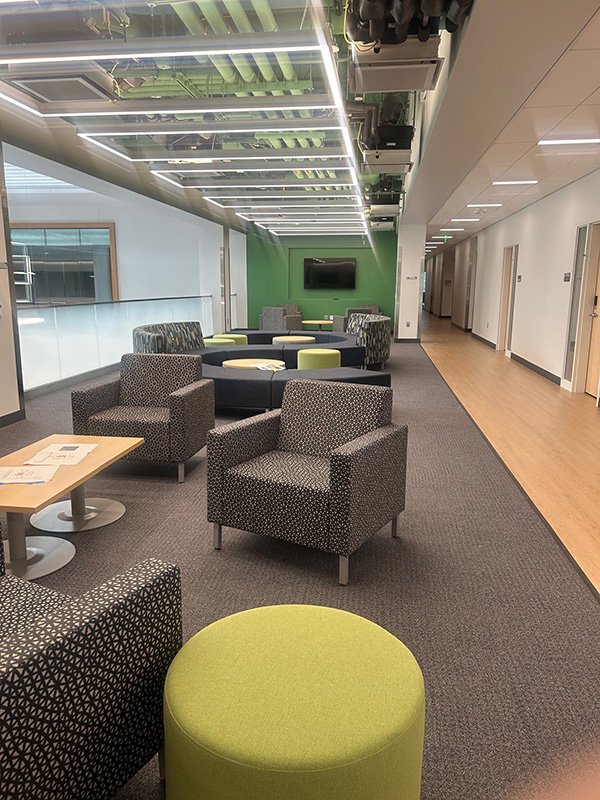 “There will be a performance area for our music department. It has special acoustics and lighting. A plethora of windows offers plenty of natural light throughout the building. One distinguishing feature is a new skylight in the center, above what will be known as the “collaborative core,” she added.
Some of the main-floor spaces include a podcast studio, newsroom and a renovated ballroom.
The second floor includes faculty and staff offices, classrooms and team rooms and sprawling design studios for art and design.
Additional highlights include a prototyping room and an animation lab shared across SCMA majors.
The lower level is designed to meet all student production needs, with two broadcasting studios, multiple audio-focused spaces (like voiceover booths), a small soundstage, a virtual reality suite, editing labs, a whitebox gallery and a film screening room. There is even a “sound room” with a variety of spaces in the floor which enables students to create sound effects such as walking on bricks, playing in water and more.
“It takes a while to get through the building and know where everything is,” Knapp said. “Maybe 50 to 60 staff will come over here — mostly just from Lanigan. Our graphic design faculty has always been working in Lanigan. We have some people that are coming here from Tyler.”
All of the studio and fine art staff is still in Tyler.
Multiple skill sets
“Gone are the days where you come and you just study one thing — get your degree in journalism, go out and be a journalist. That has changed quite a bit. Now you write, you’re your own photographer, do the design work — publishing on websites and things like that,” she said. “We are making sure that our students are career ready. That’s really important to us; and so it happens very naturally in the college of communication because students are multiple interests multiple talents. Not only are they studying journalism, they have a minor in photography and also maybe a minor in business administration or something like that — because they know they are going to need to be savvy in terms of the business world.
“We encourage our students who want to be working artists, performers to take up like an entrepreneur minor — something in the college of business or audio production — so a broadcast digital major also minors in audio design and production. There are always jobs in audio. That is a great skill set for students to build out in addition to the major programs.”
Oswego has a lot to offer
“We have film students that are double majors in theater because they want the acting and directing components. Maybe some public relations majors that want to minor in graphic design,” Knapp said. “Inter-action design and audio recording are the two newest majors in the college. But we are constantly updating — redesigning our curriculum so that we are meeting the needs of the day.
“Now it’s broadcasting and digital media that is a better descriptor for what is going on. TV news used to be the thing; you want to be on TV, you go to Oswego. Want to be a sports play by play person, that’s still true — come to Oswego. But not everyone goes into news now. So we’re making sure that they have got the digital skills, the media literacy. A lot of people want to be on YouTube as opposed to being on Channel 9.”
“So broadcasting as a term doesn’t really resonate with your average 17, 18 year old. But if you say ‘oh, you want to be a content creator, an influencer’ that is a phrase they use and understand.” She added. “Communication is my home department, but it is also the major that I teach — the human communication aspect of it. The writing, speaking persuasion. If you want to be an influencer, you ought to be a comm major. It’s all about messages.”
Hewitt Facts
Hewitt Hall, formerly known as Hewitt Union, is located to the north of Culkin Hall and south of the Academic Quad. Hewitt housed most of the student organizations until the campus center opened in 2006.
Hewitt Hall has undergone an $80 million renovation, transforming the building into a state-of-the-art facility for broadcasting, graphic design, and cinema & screen studies.
History
Hewitt housed most of the student organizations until the campus center opened in 2006. Today, the building is home to Artville, Bookland and one of several box offices on campus.
Namesake
Hewitt Hall was opened in 1967 and was named in honor of Jesse Merle Hewitt, Oswego’s first student to die in World War I. Hewitt had worked in the Industrial Arts Department at the college before he left to serve overseas.