

Oswego Lakers Hockey celebrates first All-American and olympic silver medalist Pete Sears with first-ever jersey retirement
By Tom and Jerry Caraccioli
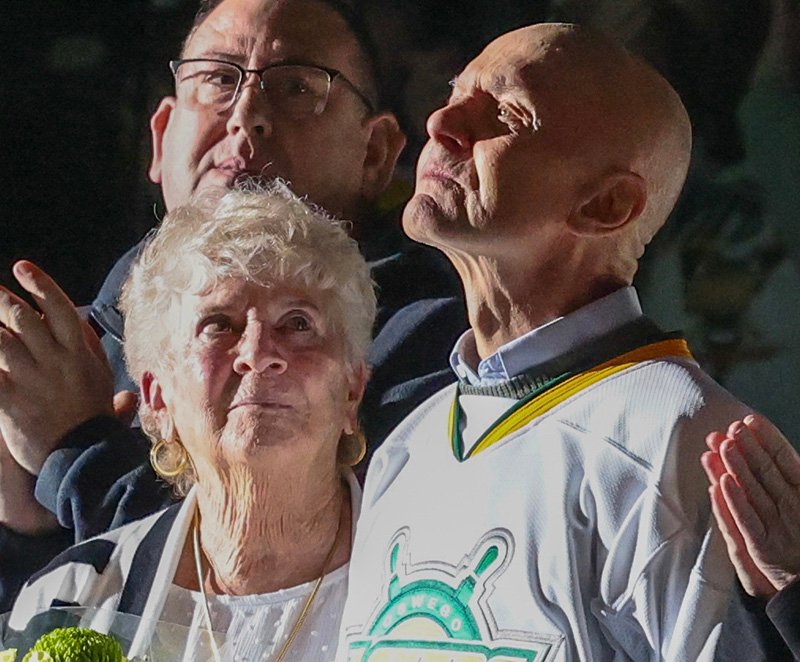
For more than 60 years, Oswego State Lakers hockey has enjoyed a storied history. On Nov. 15, 2025, the program added another chapter when it retired its first-ever jersey number of a former player.
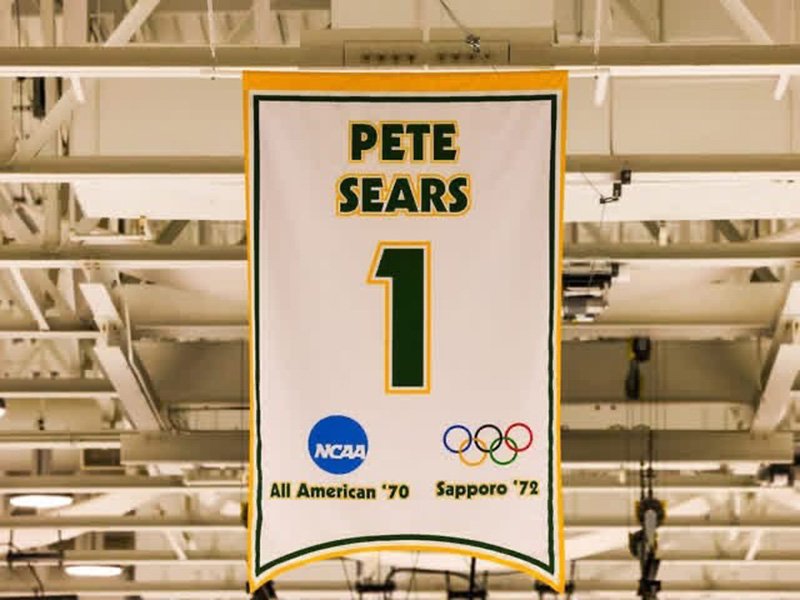
Along with banners highlighting the program’s only national championship and other NCAA appearances and SUNYAC championships, from now on Lakers fans will see the jersey No. 1 of Pete Sears hanging from the rafters of the arena.
Recognized as the Lakers’ greatest player, Sears was Oswego State’s first-ever All-American and an Olympic silver medalist as a member of the 1972 United States Olympic Hockey team at the XI Winter Olympic Games in Sapporo, Japan.
“When talk of retiring numbers of past Lakers legends began, there was only one name that was discussed about who should be first, Pete Sears,” Lakers head coach Ed Gosek said. “In the history of the program, we’ve had lots of great players, but none have been greater than Pete. Along with his athletic accomplishments, he and his wife, Kay, have been shining examples, mentors and friends to countless members of the Oswego community, myself included, for more than 50 years.”
As a native of Lake Placid, Sears had received interest from Clarkson University to attend and play in Potsdam. “I had a couple of friends that had come down to Oswego State where they had just started a program in the mid-‘60s,” Sears explained in the biography “Striking Silver: The Untold Story of America’s Forgotten Hockey Team.” He visited the campus and spoke with then-head coach George Crowe. “I went down to talk to him, watched a few games, talked with some of the players and really liked the place. That’s what convinced me.”
Sears’ academic and athletic career at Oswego State began in 1965-66 after traveling south from his North Country hometown. He quickly established himself as a premier college athlete in hockey and baseball for the Lakers. He would go on to become the hockey team’s most valuable player in 1967, ’70 and ’71, as well as the program’s first-ever All-American.
 The Laker goaltender’s collegiate career was interrupted following his sophomore season in 1967 when he left school to try out for the 1968 U.S. Olympic Hockey Team. After coach Murray Williamson told him they were set with goaltenders, he was then called into service by the United States Army to fight in the jungles of Vietnam. Upon returning to the Oswego State campus in 1969 after his tour of duty, Sears resumed his stellar play in the nets during the winter and baseball field during the spring. He was honored with an All-American selection in hockey following the 1970 season.
“Growing up in Lake Placid, you would talk with people who lived through that [the 1932 Winter Olympic Games in Lake Placid],” Sears explained. “There were a lot of people in the community who had participated in the Olympics, not in hockey but other sports. That just helped me build up an interest, probably more than a lot of kids there.”
After graduating from SUNY Oswego with his childhood Olympic dream still burning inside of him, Sears contacted Williamson again, who was coaching the 1972 U.S. Olympic hockey team as well, about trying out for the team. Williamson remembered the young goaltender from Oswego State. And this time, Sears’ dream came true as he went on to become a member of the 1972 U.S. Olympic Men’s Hockey Team that eventually won a silver medal in Sapporo, Japan.
Following his Olympic experience, he, his wife, Kay, and young daughter, Ranee, returned to the Oswego area where he began a 35-year teaching career. Sears also embarked on a coaching career starting in the Oswego Minor Hockey Association, then becoming head coach of the Oswego High School boys’ varsity hockey team. He led his teams to 10 Central New York Section III League titles, five Section III championships and three appearances in the New York State Division I Boy’s High School Hockey Championship game. Also, along the way, his teams garnered nine New York State Sportsmanship Awards.
“Pete has been a part of our program from the very beginning,” Gosek said. “He has inspired thousands of us in the Oswego community, as well as Central New York and beyond. This is a well-deserved honor.”
Today, nearly 55 years after playing in Golden Romney Fieldhouse, a former World War II surplus airplane hangar, Sears’ No. 1 jersey has been immortalized in the state-of-the-art Deborah F. Stanley Convocation Hall and Arena never to be worn again by a Lakers player.
Tom and Jerry Caraccioli are freelance writers originally from Oswego, who have co-authored three books: “Striking Silver: The Untold Story of America’s Forgotten Hockey Team,” BOYCOTT: Stolen Dreams of the 1980 Moscow Olympic Games” and “Ice Breakers: A Kid’s Guide to Hockey and the Greatest Players Who Changed the Game.” They also host a monthly television and multi-platform segment on WSYR-Channel 9 (ABC) on its “Bridge Street” show called “Backroads to Bridge Street with Tom & Jerry.”