

SUNY Oswego associate professor Rengian Yang emigrated from her home in Hunan, China, after receiving her Bachelor of Fine Arts degree in ceramics from the Sichuan Fine Arts Institute in 2009.
By Tom and Jerry Caraccioli
 Rooted in the philosophy of Confucianism and Taoism, SUNY Oswego associate professor Rengian Yang introduces art in her classroom as a way to create a flow that embraces the mind, body and spirit in order to tell a story through ceramic forms, color, texture and geometry.
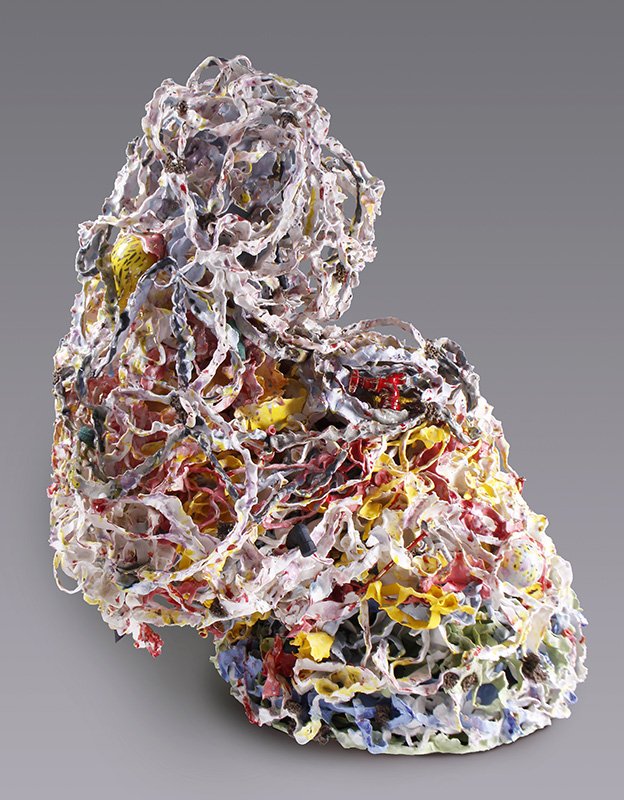
For Yang, her art and how she teaches reflects a story in which her experiences of life growing up in China and now living in the United States has been a major theme. Her most recent exhibit at the Everson Museum in Syracuse — “Neither Here Nor Elsewhere” — was a solo exhibit which included abstract sculpture pieces that took two years to create and highlighted her fascinating story without words through emotions, experiences and memories.
“Over the last couple of years, my work has been inspired by my personal experiences living between China and the U.S.,” Yang explained. “A lot of the work includes stories about emotions that you cannot describe or name. Language develops in a way in which not everything can be translated. That is why this [ceramic art] is a visual language. What this sculpture does is create spaces between emotions, memory and my personal experience. Half of the work I created during my sabbatical residency in Jingdezhen, China. This is the place where blue and white porcelain was invented.”
Yang emigrated from her home in Hunan, China, after receiving her Bachelor of Fine Arts degree in ceramics from the Sichuan Fine Arts Institute in 2009 and working on her art for several years in her homeland. Upon leaving China, she landed in the United States and Syracuse University where she earned her Master of Fine Arts degree in 2014.
“I grew up in Hunan, China, which is near a lake. A fortune teller once told me that I will have a good life if I remain by a lake,” Yang laughingly remembered. “My first experience in America was Syracuse. I had never seen so much snow in my life. It was quite a culture shock.”
 Her journey to SUNY Oswego began in 2017 when she joined the faculty and staff of Oswego’s Art & Design Department teaching ceramics. Nearly 10 years later, she thrives as a passionate art teacher and noted artist from Central New York. And she is no longer surprised by the snow.
Feedback about Yang’s exhibition has been informative. Part of her work displays the natural world. In the exhibition many of the pieces have more geometric shapes and others have more organic shapes morphing together. These pieces signify emotion as something that grows, spreads and something that actually exists.
“I’m trying to create things that are abstract — that exist in your heart or your head or how you feel — but are also three dimensional so when you’re seeing it you can be inspired to connect these elements with nature too,” Yang explained. “I’m telling the story by connecting the narratives of each side of the piece because each side tells a part of the overall story. It’s almost like reading a book. I want people to be curious about what the other side looks like, to walk around the piece and experience more than one point of view. The reason I mentioned the story about the blue and white porcelain is because I included that as a motif from the city of Jingdezhen. A lot of it has to do with what my eyes have seen, my emotions and my experiences. I’m connecting memory, history and time in one piece.
“It doesn’t have to be my interpretation of the work. It’s really open to the people who go to the exhibition and experience the art by slowing down, really slowing down and paying attention to all the details of the work. If you walk around the sculpture as a three-dimensional piece, every side tells a story.”
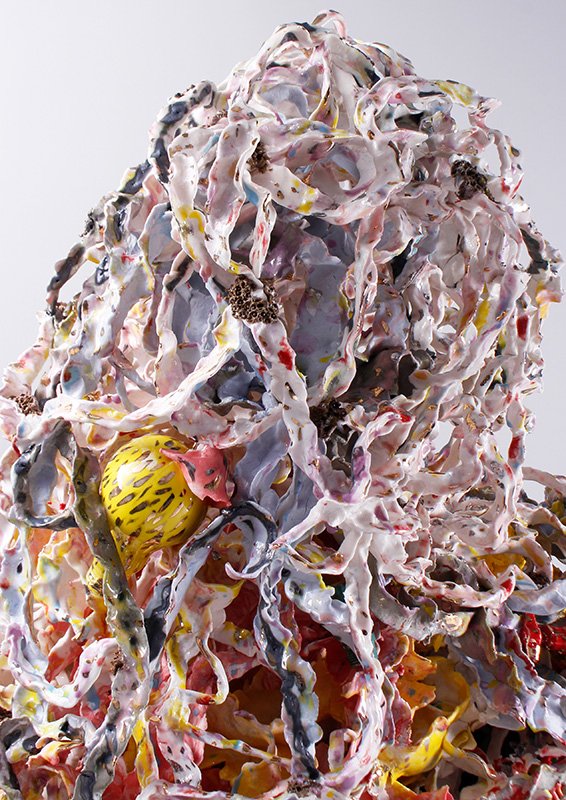 The use of color in her work and teaching is another important aspect of Yang’s work. Her earlier work in China involved exclusively using red because it is a controversial color.
“In China, the Eastern hemisphere, red is a wedding color, very happy and positive. Mostly, in the Western hemisphere, red represents violence, death, fire, a lot of things that aren’t pleasant,” she said. “I love the duality in this one color. I was using a lot of red for my sculpture work.”
Yang’s earlier work is based on Chinese stories and is nearly always misinterpreted in the West, which she, admittedly loves. “You want your art to bridge the gap between what you’re thinking and what you’re creating,” she explained. “But you also want to create that gap about how you see your work and how other people interpret your work. That’s the best because the work you create has its own life. When other people interact, the life continues. If I decide what the piece means it doesn’t grow. It doesn’t influence. It doesn’t connect with people.”
Those are the ideas Yang introduces in the classroom as well in her requisite courses for art majors and elective for others interested in artistic expression. Her classes strive to become a sacred creative zone where students can come, create and really connect with the process.
“There is a journey they have to take in order to master and really get to know how to work with this material,” Yang said. “We have pieces explode in the kiln, which is very common. Students can spend months making a piece and things can go wrong in the kiln. That, in and of itself, teaches them a life lesson of hope. It also connects what we learn in the classroom and what happens in real life. Things don’t always play out the way you want. So, how do you deal with it? Do you give up or do you start over?”
Tom and Jerry Caraccioli are freelance writers from Oswego, who have co-authored three books, mostly about hockey: They also host a monthly television and multi-platform segment on WSYR-Channel 9 (ABC) — “Backroads to Bridge Street with Tom & Jerry.”